

When I heard about Shadowdark in 2023 my first thought was, “It looks cool, but I’ve got some games that already scratch those itches so I’m not sure I need it.” When people kept bringing it up during its Kickstarter, however, I figured I had to be missing something and downloaded the quick start PDF.
I was hooked. So hooked, in fact, that I attempted my first actual play live stream just to try out the system! Had Dragonbane not been released around the same time as Shadowdark it would be, by far, my favorite fantasy system to run. As it is, Shadowdark is ranked 1a in my mental list.
I’m breaking up my Shadowdark review into two parts. Part 1 will cover my favorite key features of the system, while part 2 will cover the book as physical product. Let’s dive in.
Key Features
One of the comments detractors will make about Shadowdark is that it’s “not original,” which isn’t untrue. Much of what Kelsey Dionne put into Shadowdark has been part of other games she’s played. What detractors fail to understand, however, is this isn’t the insult they seem to think it is. Kelsey has taken these different parts and woven them together into a unique system that’s fast, intuitive, and fun. Let’s take a look at some of favorite Shadowdark features.
D20 based
Much like Fifth Edition Dungeons & Dragons, or 5e, 1 Shadowdark’s tests are all rolled on a d20 against a Difficulty Class. There are no mechanic switches for special abilities, such as turning undead or thief skills, which had different mechanics prior to Third Edition. Turning undead, for example, is now just one spell a Priest may trigger. Armor Class also fits the d20 design and uses an ascending scale. An adversary’s AC is the target number needed to hit.
Shadowdark also takes the advantage disadvantage mechanic from 5e, where players roll two twenty sided dice and take either the higher result for advantage for the lower for disadvantage.
There are a few exceptions to the d20 rule. The monster reaction mechanic, for example, uses the classic 2d6 check from old school Dungeons & Dragons. This is a table that’s so ingrained in my memory that I use it by default in just about any system I run. I’m pleased to find it included in the game, even if it does break some consistency.
Simple character design
The core book has six ancestries: Dwarf, Elf, Goblin, Half-Orc, Halfling, and Human. Each has a special benefit from their ancestry, such as the Elf’s “far sight” ability that gives them a +1 bonus with ranged weapons or spell checks 2, and each benefit creates a nice distinction for game play.
Shadowdark also limits itself to four classes in the core book: Fighter, Priest, Thief, and Wizard. Each class begins play with some special abilities which are tied to their in-game role. Fighters, for example, get a +1 to attack and damage rolls with a specific weapon they have mastered. They also add half their level to rolls using that weapon, rounded down. While some players may balk at giving fighters such a mathematical benefit, this is a concept which has been present from the very start of the D&D family tree. Original D&D only applied strength modifiers for attack and damage to the “Fighting Man” class, which is a carried on today in games like Swords & Wizardry and White Box. It’s nice to see such an old concept make a come back in a modern game.
In addition to the talents which are common to every character in a class, there is also a random 2d6 table players roll on when they level up, including a roll at level 1. These are different or each class but follow a similar pattern–bonuses in checks common for the class, an improvement to a class ability, or an attribute increase. It’s a nice way to demonstrate how the characters are gaining competence the longer they survive.

Shadowdark uses the six traditional attribute scores: Strength, Dexterity, Constitution, Intelligence, Wisdom, and Charisma. The modifiers for the different scores, however, follow the 5e scale–scores of one to three have a -4 modifier, all the way up to +4 for a score of eighteen or over. This is one way Shadowdark functions as a bridge between old school and modern play. In a nod to old school play, however, attribute scores are generated by rolling 3d6 down the line.
In another nod to the old school, there are only three alignments in the game: Chaotic, Lawful, and Neutral. I know it’s a bit of a hot take, but I have never like the single axis alignment system–mostly because it never quite accomplished the goal of linking characters to universal cosmic principals which are beyond the cultural concepts of good and evil. Even in Shadowdark “Lawful” is still described in language most often interpreted as “good” and chaos with language which is typically interpreted as “evil.” This is my personal take, but its inclusion here may be my only ding on the game. I’ve come to prefer playing with no alignment, characters show who they are by what they do.
The simplicity of character creation is wonderful. Even better, should players choose, they can roll up their characters through all random rolls. The stats get rolled 3d6 down the line, followed by a d6 for Ancestry, a d4 for class, and a d20 for their background. They can finish off by rolling 2d6 twice–once for their character’s talent and a second time for their starting coin. It’s fast and fun.
Roll to cast magic
Shadowdark takes a nod from Dungeon Crawl Classics and makes spells a rolled skill. Wizards and Priests have a number of spells they know, based on their level, but they can attempt to cast those spells as many times as they want per day. The Difficulty Class for casting is ten plus the spell’s tier, so higher level spells become a more risky proposition!
If spell roll is failed then that spell is gone until the player completes a rest. If the spell check rolls a one then the casting suffers a critical failure. Similar to Dungeon Crawl Classics, Wizards suffer a mishap and have roll on the mishap table which corresponds to the failed spell’s tier. Mishaps are bad, and can do serious harm to the caster or their party, but they don’t get quite as gruesome as the results found in DCC. The more light-hearted tone fits my play style better, but if players want more “grim” in their game they can always make the mishap tables more hard core.
Critical failures for a priest, on the other hand, trigger the displeasure of the character’s deity. In order to regain access to the spell they will need to complete a ritual penance by making a sacrifice whose value is commensurate with the spell’s tier. I do wish there were “divine smite” tables to handle priest spell mishaps so every caster could have opportunity to endure the wackiness, but I do like that a priest who upsets their deity needs to do more than rest in order to regain access to the spell.
I love the casting mechanics in Shadowdark. It’s a great blend of risk and reward.
Lots of danger
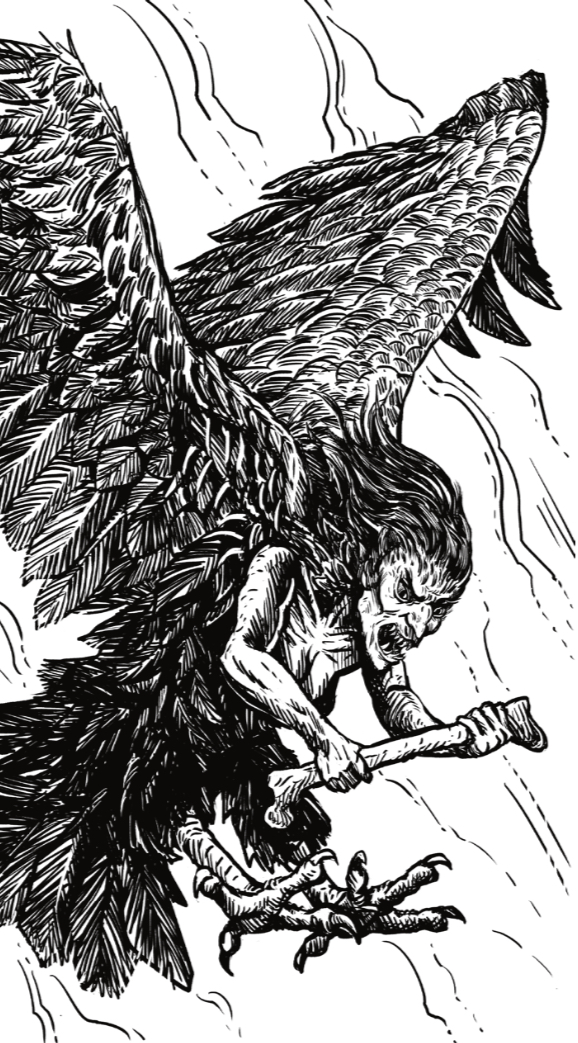
One of the key features for Shadowdark is no character has dark vision. Monsters, on the other hand, see in the dark just fine. Having a light source, then, is essential. Without light a situation becomes deadly and a random encounter check is made every round.
Light sources also burn in real time, typically for one hour. This increases the tension as the timer continues to wind down to zero. It also speeds up play because spending fifteen minutes discussing something which occurs in-game in about fifteen seconds is not an option. One of my groups ran a funnel recently and the real-time torch burning was one of my favorite aspects of the game!
Hit points are low. Hit dice for the classes have all been reduced from their 5e values by one type, placing hit points back in the range of old school games. Walking around with a thief who has three hit points can create a bit of tension when a sneak check fails and the character gets discovered on their way to a backstab!
When a character hits zero hit points the player rolls a d4 and adds their Constitution modifier. That number, with a minimum of 1, is how many turns the character has until they die. Each time their initiative comes up the player rolls a d20, if they roll a 20 the character recovers and rises with 1 hit point. Should a character be able to assist the downed party member they can attempt a DC 15 Intelligence check to stabilize the fallen character. On a success the character is no longer dying, but remains unconscious. I like this death mechanic. I find it to be a tad more lethal than the -10 HP rule I was taught back in the day, and remains part of games like Castles & Crusades and Basic Fantasy RPG 3.
Conclusion
2023 saw a number of terrific fantasy games hit the market, and Shadowdark is right at the top. Yes it pulls in from a number of other games, but it sews these parts into a fantastic new whole which is a joy to run. Its simplicity, fast game play, and built-in tension make the game a lot of fun. If you haven’t played Shadowdark yet, this one is worth checking out!
-
It’s only the 5th Edition of the Advanced line, to be more accurate, and people even argue about that. Fans are weird. ↩
-
“What do your elven eyes see?” is a thing in this game. ↩
-
Though in BFRPG it’s an optional rule. ↩

One response to “Shadowdark, Part 1”
[…] This is part 2 of my ShadowDark review 1, which covers the product design and interior layout. If you’d like to read about the game itself, follow this link. […]
LikeLike