
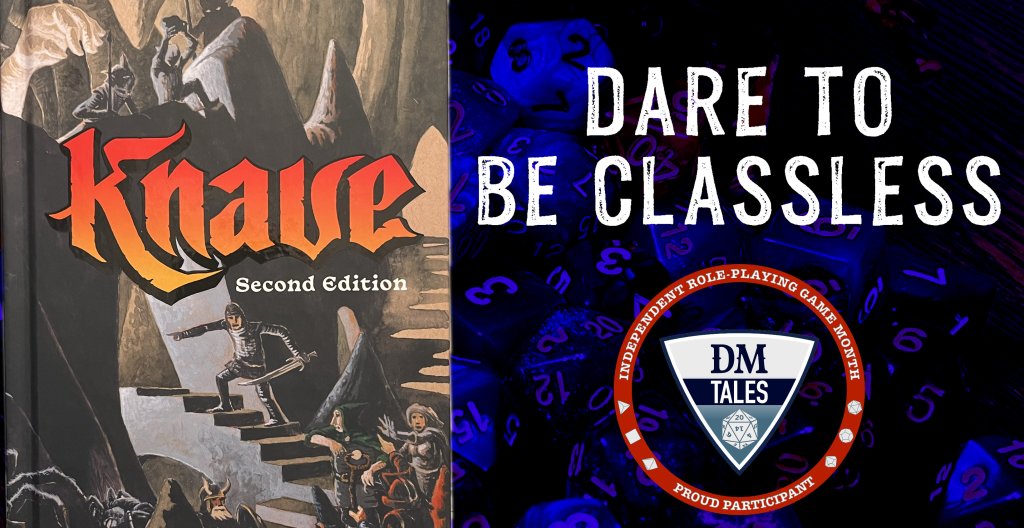

I had heard about Knave prior to its second edition Kickstarter, but hadn’t had an opportunity to dive into it before the second edition was announced. So when the 2e campaign opened I jumped in as a backer. My copy arrived the other day and I’ve had a chance to read the book and play around some with the included tables. I’ve got to say, I’m intrigued. Let’s take a look.
Core Mechanics
Knave 2e is a d20 based game where players must meet or beat a set difficulty, usually 11 + 5. Rolls are modified by the character’s attribute scores, and advantage/disadvantage on checks occurs in ± 5 increments.
Frivolous checks are discouraged, and the game’s example for these are “knowledge checks.” Characters are assumed to have all relevant common or career knowledge they’d need to function in the game world. If characters want to know something else, they will need to spend some time researching it.
Travel is simple. A watch is four hours, and a party can move one 6 mile hex per watch, and up to three watches per day. Pushing beyond this limit can harm the characters. Navigating confusing terrain will require a check, and players can also spend a watch exploring for hidden features or foraging for food if they so desire.
Dungeon crawling is also simplified. Time is broken into 10 minute turns, and there are three speeds at which a party may explore–crawling, walking, or running. If a party crawls all traps are detected and the group can map the dungeon. If they walk they move faster per turn but all traps are triggered and the party are surprised by all encounters. They may, however, still map the dungeon. If they run the same penalties for walking apply, but light sources may blow out and mapping is impossible.
Building a Character
Characters have six stats, which are familiar to anyone who has played the ampersand game–Strength, Dexterity, Constitution, Intelligence, Wisdom, and Charisma. Scores are rated 0-10, and serve as modifiers for any checks using that ability. During character creation players have three points to assign to the scores, they may do so as they desire or roll 3d6 and apply the points to the associated value. For example, rolling “2, 5, 3” would result in points assigned to Dexterity, Wisdom, and Constitution.
Characters begin game with 10+Constitution in item slots and 1d6 Hit Points. There is a standard kit list for starting characters, but players also roll for, or choose, two professions from a table on page 5. These professions provide starting characters with additional gear. Players are free to choose any armor or weapons they want, but cannot exceed their equipment slots.
There are no classes in the game, and any character may cast a spell as long as they possess a spell book, which takes up an item slot. Characters who begin play with points in Intelligence may acquire one as part of their starting gear.
And that’s it. If players want help rounding out their character they can use the random tables on pages 54-59 to generate a name, motivation, and defining traits.
Advancement is experience based, and when a PC attains a new level they re-roll all their Hit Dice for a new total (adding 1 to the previous total if the new roll is lower). They also gain three more points they may assign to their attribute scores.
About Magic
As stated above, there are no classes in Knave 2e. Anyone who acquires a spellbook is able to cast a spell, and each book can be used once per day. Most spellbooks allow the same spell to be cast day after day, but others are “Chaos Spellbooks”–these books rewrite themselves each day to allow for a new spell to be cast. When combined with the “Generating New Spells” tables, found on pages 27-31, these tools could be a ton of fun for inventive players–working with their GM, of course.
Characters are able to use a number of spell books per day equal to their Intelligence score. Unwilling spell targets may make a save to resist a spell’s effect. The target number to meet or beat is 10 + the spell’s level (I think that’s the caster’s level). A success halves the effect, beating it by 10 or more negates the spell.
About Relics
Knave 2e represents divine magic with “Relics.” These are objects which are bound to a single divine patron, each of which has their own domain of influence. Players may attempt to create relics by communing with a patron at a local shrine. When this request is made, the patron will give the supplicant a quest to undertake–something related to its domain of influence. If completed, the patron will transform the proffered item into a relic.
Relics bestow useful, but small, effects on their owners–and GMs are encouraged to use the various magical tables in the book to develop the blessing with the player. These items must, however, be used in conjunction with the patron’s domain or the blessing will be revoked. The reverse is also true, a character who strives to remain in a patron’s good graces may be rewarded with greater blessings! Players may have a number of active blessings equal to their Charisma score.
About Alchemy
Knave 2e includes simple rules for brewing potions, found on pages 35-37. Players declare what potion effect they’re going for, as well as the ingredients they desire to use in the process. The GM can either agree with the proposed formula or negotiate a bit to make the potion’s cost commensurate with its in-game effect. Once the requirements have been settled, and the ingredients procured, the brewing process can begin. It takes 1 shift to brew and the player brewing the potions will need to make an intelligence check (usually 16) for a successful process. If they have in-game time, however, players can use a second shift to brew their concoction. This will award a +5 advantage to the check. If a player beats the target by 10 or more they also discover a recipe for making for the brew. In the future, should they use the same ingredients, the Intelligence check to brew the potion is waved.
Potion ingredients will often be monster parts, which should appeal to fans of a certain video game franchise. Each harvested monster part takes up one item slot on the character sheet.
Combat & Damage
An age-old ampersand game argument is over the difference between wisdom and intelligence. Knave 2e takes care of this in a unique way, Intelligence is used for magical activites, as one might expect, while Wisdom is used as a character’s modifier for ranged attacks. As with many other games, melee attacks are modified by Strength.
Initiative is side-based. The leaders of both sides make a Charisma check, and the winning side goes first.
Attack rolls are simple. To hit with an attack, the player must meet or beat the target’s armor class–10 plus the number of armor pieces the target carries. If the die comes up a 1, the weapon used in the attack breaks. If the result is 21 or more the player may attempt an extra maneuver (like a trip or shove) using an appropriate attribute check.
Damage is where things get interesting. Each weapon in the game has a damage die–a d4 up to a d8–and damage is taken from a target’s Hit Points. When an NPC falls to 0 HP it dies, that’s the end. When a PC falls to 0 HP, however, damage continues to be inflicted on the character’s item slots–this damage is called a “wound.” Any items held in that slot are dropped, so having some strategy in how the items are organized is a good idea. After all, dropping armor pieces will lower a character’s armor class! When a character is out of item slots they die. Characters can also suffer direct damage, which bypasses Hit Points and affects item slots only. While Hit Points are restored after a two shift rest wounds only heal at a rate of one per day, and even then only in a place of safety.
This is a straight-forward system with some nice depth. I like it!
Layout
Referring to Knave 2e as “rules lite” might be an insult to the genius of its simple clarity. Every one of the rules in the “Core Mechanics” section of this review are found, for example, on the front and back interior cover pages of the book. Opening up the front cover is, by itself, enough information for a GM to run an encounter. This is brilliant.
Knave 2e’s art is done by Peter Mullen and is line art classic. Images are brooding, dangerous, and remind players that adventurers are small in a world of huge peril. I love it.
The body text is a clear serif-font with good spacing. It’s no-frills but it gets the job done. The body is presented in two columns and is easy to read.
There are two heading levels in the book. First level headings function as section headers and are presented in a nice Old English font. I’m a sucker for these when the glyphs are readable, and these are easy reading. Second level headings a presented in all caps in-line with the body text and utilize a bold font which is a bit smaller than the body text. If it’s not the same font as the body text, it’s a similar serif face.
There are two kinds of tables in the book.
The majority are d100 tables, which are presented in two columns. Some of these tables take up an entire page, while others will be laid out two to a page. Result numbers and titles (when the latter appear) utilize the second level heading font, and the descriptions use a smaller size body font. Other than a table-spanning title, white text against a black field, there are no other table decorations like borders or alternating row colors. One might expect this to make the tables difficult to read, but that’s not the case. The bold result numbers help with readability, and folks who use this book will want to read the d100 tables. They are a dragon’s hoard of ideas to bring into any game!
The second kind of table is for any number of results under 100, and utilizes the same basic design, but with two distinctions. First, the results are presented in a single column. Second, these tables utilize an alternating row color to assist readability.
Everything in the book flows well.
Book Design
Knave 2e is an 8 ½ by 5 ½ inch book which feels every bit as portable as A5 “digest” size books like Shadowdark and Old School Essentials. It’s stitch binding, so the book will last a while, but it does not have a book ribbon. In normal circumstances this omission would be a “ding” for me, but the book’s so condensed it’s not really needed. I read it in about an hour and can flip through the pages in a few seconds. Also, as stated above, the bulk of information a GM needs is printed on the interior covers. Knave 2e is also printed on flat-paper, which is always a win!
Conclusion
If you’re looking for a rules lite game that is fluid, fun, dangerous, and fast Knave 2e is a terrific option. It’s not quite as gonzo as EZd6, but reads like it’s a lot of fun. The game is also a fantastic resource for world building using the abundant d100 tables, so this is one of those TTRPG books you can pick up guilt free even if you never plan on running the actual game!
The print book can be purchased for [\(35** from swordfishislands](https://shop.swordfishislands.com/questing-beast/) and PDFs are on sale from both [DriveThruRPG](https://www.drivethrurpg.com/en/product/484910/knave-second-edition?affiliate\_id=379088) and [Itch IO](https://questingbeast.itch.io/knave-second-edition) for **\)19.99.
