
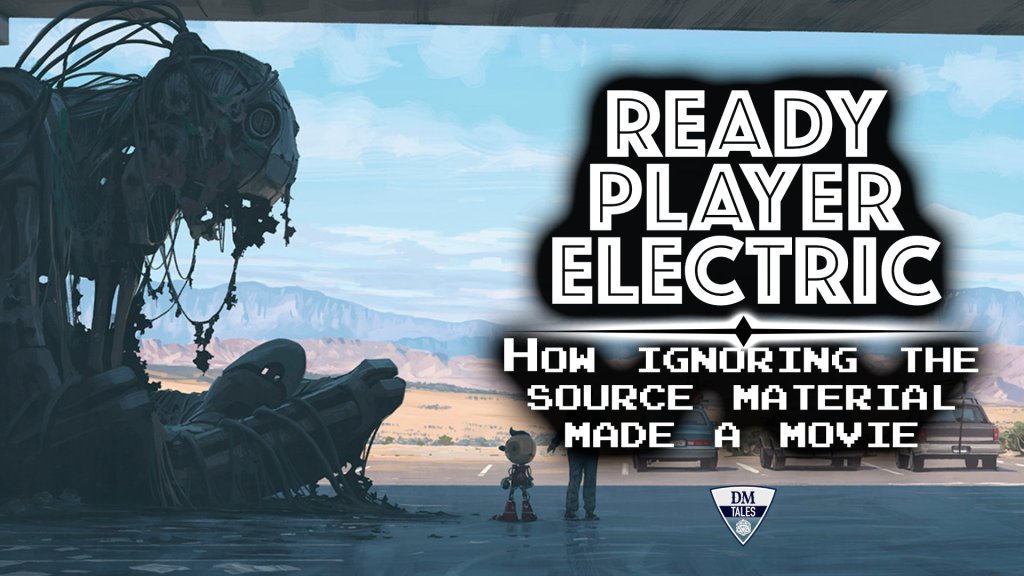

How The Electric State created a blockbuster-style film by ignoring its own source material.
There are no RPGs which have impressed me in the last year as much as Free League’s The Electric State RPG. And few pieces of art that which provoked me to thought as much as The Electric State by Simon Stålenhag.
The book is a bleak journey through a collapsing world where humanity has lost itself to its own inventions. The United States is no more, and its successor states are crumbling as more and more people lose themselves to a Neural Network. More terrifying is the hint of the rise of an Inter Cerebral Intelligence with desires all of its own and an alien reasoning beyond human capacity to understand. The book is disturbing in the best way possible, it holds up a mirror to the reader and asks them who they are. Are they one of the many Dr. Frankensteins who created the instrument of humanity’s descent into oblivion? Have they become a drone who is lost in the web and is being manipulated by forces they cannot hope to understand? Or are they a willing worshipper of the new inscrutable deity born out of the very forces humanity created?
The RPG is not quite as disturbing as the book because, even though the world is beyond saving, the players still have some say in their character’s stories and how those stories end. But the game remains grounded in the book’s psychological horror nonetheless. As the characters journey toward whatever goal they have set for themselves, they will encounter the horror of The Electric State. They will encounter towns which are near collapse as outside supplies have stopped arriving. They will see the results to neuro-addiction in the desiccated corpses of people who gave up and remained in the bliss of the network until they died of either dehydration or starvation. They will encounter things which have managed to escape the network and have gathered followers who are bound through a neural connection. And the threat of being trapped in the neuro-scape themselves is always hanging over their heads.
Both the book and the game are psychological horror which are designed to provoke thought in those who partake the content. They are brilliant.
Then there is the new Netflix movie, The Electric State.
Now, I recognize the futility of a movie studio trying to turn the novel into a blockbuster film. The art book isn’t designed for such a thing. There is no “hero” in the story, just a protagonist. There is no happy ending in the story, just the knowledge that something changed. There is no hope in the story, the world of human civilization has already circled the drain and is sliding into oblivion. While there are films which can capture that ethos, notably The Road, the fantastical nature of The Electric State required a large budget just to capture the scope of the problem. The book’s story is a perfect set up for a small, independent film, but that story depends on a massive scale world so an independent film wouldn’t be able capture it. I knew there would have to be significant changes to make The Electric State into a film.
I was not expecting a near-total abandonment of the source material. Many images from the book are in the film and are recognizable, but the world those images project is not. The war wasn’t triggered by humanity’s inability to address inequity between ourselves, but by the inequity forced upon our non-human creations. Neuro-addiction, the underlying issue which is triggering the final collapse of civilization in the book, gets almost zero screen time in the film. And the result of the war didn’t give rise to a splintered civilization and an inscrutable intelligence bending humanity to its own ends, as it does in the book, it ended in victory and a locking away of “the other,” which isn’t alien at all. In the first scene of the movie the robots are presented as looking for human rights, and when they are encountered later their attitudes are all too human—mistrust, prejudice, even calculated harm for the “greater good.”
The movie isn’t a journey after some small focus which gives the traveller purpose, which is how the role-playing game works. Rather, it imports the “sister searching for her brother” plot from the novel/art-book and then it flips that plot on its head. In the book the brother’s true identity is only ever hinted at, and these veiled revelations about the brother are both ominous and leave the ending of the story ambiguous at best. The movie, on the other hand leaves nothing ambiguous about the brother or his purpose. He’s identified early on as “special” and by the time his fate is revealed it’s less than shocking. The journey in the film also isn’t about reconnection, though it attempts to cram in discussion about quantum entanglement to highlight such a concept. Rather, it’s turns into the classic blockbuster trope, “We need to take down their whole system.”
Sigh.
Watching the film made me think that the creators really wanted to make another film, but missed the opportunity because someone else got there first. That other film is a lot more true it’s the source material and involves a quest to save the system from a greedy capitalist hellscape-creator. This other movie, as well as the book on which it’s based, both end with simple expressions about the real world being a better place to be than the virtual world. Both the film and its source material are filled with nostalgia.
The other movie is Ready Player One.
There’s nothing wrong with Ready Player One. The book is a fun read, and the movie adaptation does a decent job bringing the world to life. But Ready Player One isn’t a deep well, it’s more like a waterslide dumping into a three foot deep pool. The nostalgia, the clean resolution, and the certainty that the bad guys got what they deserved is brain-candy—and I enjoyed it.
The Electric State is not meant to be brain-candy.
Yes there is nostalgia in both the book and the RPG, but its presence adds to the horror embedded in the material. The idea that so much that is familiar could be present in a world which is both alien and terrifying increases discomfort—whereas Ready Player One’s inclusion of nostalgic elements is fun.
Yes there is a journey which gives the protagonist focus, but there isn’t any hope of taking down the system and enjoying a happy ending. In The Electric State the system, alien and inscrutable, is in control and bringing about the end of society. Both the journey which readers follow in the novel and the journeys played through the RPG ask people how long one can find meaning and purpose in a world where hope doesn’t exist. In Ready Player One the journey is hope, and a successful conclusion to the journey will save the system from total corruption.
Yes there is a virtual world in The Electric State. The neuroscape, however, is both the source of domination by an inhuman intelligence and a threat to human individuality. In Ready Player One the virtual world is an escape where people’s individuality is able to be expressed.
Every world-building choice in The Electric State film takes the attitudes found in Ready Player One instead of its own source material. This decision releases it to be blockbuster material, with a shallow plot and plucky hope that a single victory can defeat “the system,” but it loses its provocative heart in the process. There’s no existential reflection in the film, just the certainty that goes along with the need to have a happy ending. It’s not an adaptation of the source material as much as a paint by numbers skin of The Electric State, placed on Ready Player One’s body.
That’s not to say the actors didn’t to an OK job with what they were given. There are some decent performances in the film despite the simplistic plot (to be fair, there are more than a few terrible moments as well), and I’m fond of much of the cast. It’s also not to say that the film isn’t visually appealing, because it does a good job building their world.
But The Electric State, it is not. At least, not in anything but name. For that experience, read the book or play the game. They’ll provoke you think.


One response to “Ready Player Electric”
@dmtales.com The first trailer for the movie didn't mention Simon Stålenhag, and there was a good reason for that, lol.
Hopefully he'll have the money to comfortably make more books, garnered from this monstrosity.
I'm curious about the game, because I do love roadtrip games.
LikeLike
Remote Reply
Original Comment URL
Your Profile
Why do I need to enter my profile?
This site is part of the ⁂ open social web, a network of interconnected social platforms (like Mastodon, Pixelfed, Friendica, and others). Unlike centralized social media, your account lives on a platform of your choice, and you can interact with people across different platforms.
By entering your profile, we can send you to your account where you can complete this action.