

There were few games which captured my interest back in the day like Shadowrun. The magic-punk dystopian world, set in the back alleys of a cyberpunk Seattle, blew my mind.
One of my first forays back into fantasy gaming as an adult was Munchkin. Friends gave me the core deck as a birthday gift on year and I thought it was hysterical fun. I haven’t played the game since my friends moved away, but it sits on my shelf, asking me what’s up.
So when I saw that Steve Jackson games was releasing Munchkin Shadowrun, and was offering review copies at Pax Unplugged, I jumped at the opportunity.
So, thank you to Steve Jackson Games for the review copy, I am grateful. I have received no compensation for this review, nor am I expected to say nice things about the game. These are, as always, my free and fair thoughts.
Contents
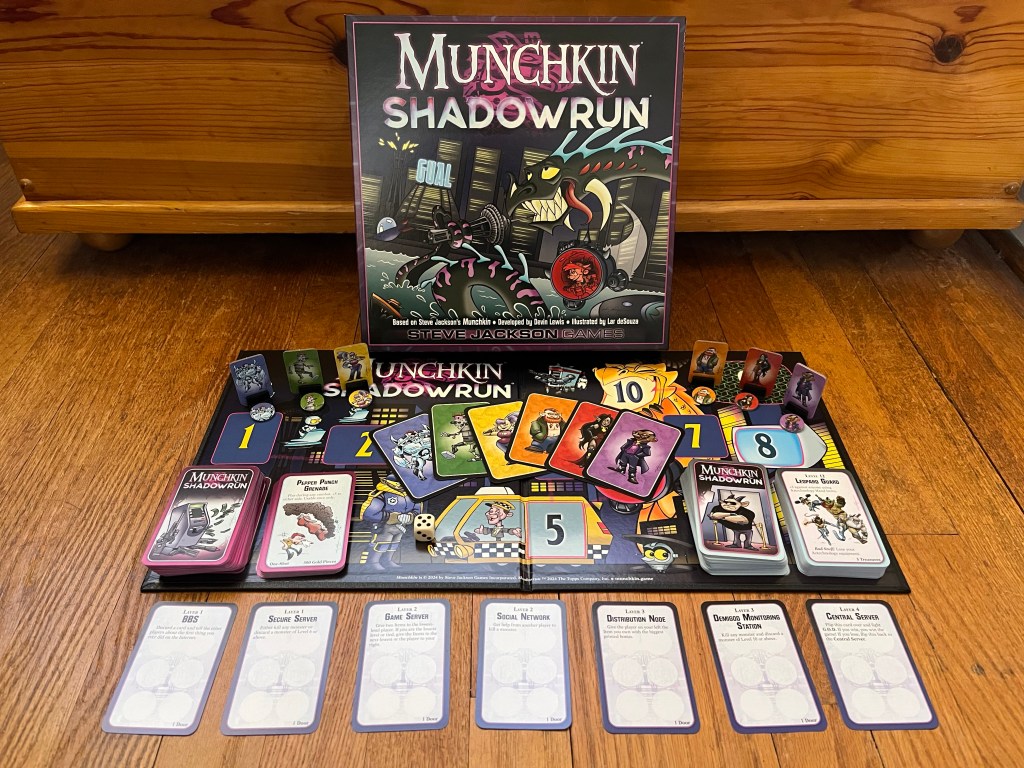
Munchkin Shadowrun comes in a compact square box, measuring 10 ½ x 10 ½ inches. Inside is a single-fold board, measuring 10 x 20 inches when expanded. This board has spots marking the different levels, places for the Treasure and Door decks, and the discard pile for each of those decks. The board isn’t essential to the game but it does make organizing a lot easier.
The aforementioned Treasure and Door decks look good. Each displays artwork which does an admirable job depicting Shadowrun’s magic-punk theme. My one distraction is the use of a gradient for these card’s borders. It’s a minor thing, but when cards get placed in the deck “upside-down” my brain glitches when I see the different color poking out and I wonder if I’ve got the card in the wrong deck. This could be deliberate, because these cards do have a correct orientation, but I found it nagged at my brain a bit too much.
Also included in the box are six character cards, along with corresponding standees and tokens, so players don’t forget who they are playing. These are colorful and have some wonderful artwork. The final contents are a ten card “Matrix” deck (double-sided), a nice-looking six side die, and a six page tri-folded instruction booklet.
The packaging is compact, looks good, and is easy to store. I quite like it.
Design and Artwork
One of my questions coming into the game was how well Munchkin could meld with Shadowrun. The latter is grimy and bleak, while the former is presented as whimsical and cartoony.
The artwork does a terrific job melding the two. Combined Cyberpunk and Fantasy concepts appear throughout the game’s art. They are in Munchkin’s cartoony style, and lose some of Shadowrun’s more grim nature—but that aspect of Shadowrun comes out in gameplay. More on that in a bit.
The game’s design also manages to include Shadowrun lore. This is a most noticeable in the treasure cards, where equipment is listed with one of Shadowrun’s fictional corporations as the manufacturer.
On the other hand, I would have enjoyed some more design going into the Matrix deck. The Matrix cards are double-sided, which doubles the options for game play, but in Shadowrun the digital world is as much part of the reality as the physical world. A depiction of cyber-security elements or hacker terminals would have been cool to see on these cards.
Setup
Set up is simple. The board is unfolded and the Treasure and Door decks are placed in their spaces. The Matrix cards are then separated by level and “shuffled” (there’s only three cards for the first three levels, and one for the fourth, so this is not difficult). These are then laid out by the board, two cards for each Matrix level except for the fourth—the excess Matrix cards are set aside.
Players select a character, placing their standee on the board and their token on the first Matrix card. Each player is dealt four cards from both the Treasure and Door Decks and may play any cards they able before the first turn of the game. This includes weapons, powers, a race, armor, and any advancement cards they may have been dealt. Players are allowed to have two single-hand weapons, or a single two-handed weapon, active at any time. Armor pieces cannot be duplicated, only one of each piece of armor can be worn at a time, and active powers can never exceed the character’s current level. If a player ever wants to replace a played card they may discard it and replace it with a card from their hand. If it’s during a time when the move is allowed, that is.
Once all the characters are created, everyone rolls the d6. The highest roll goes first and play moves clockwise around the table.
Gameplay
The Basics
Munchkin gameplay occurs in phases.
First, the player must Kick Down the Door. The player draws from the Door deck. If the card reveals a monster the player must fight it. If the card is a trap its effect on the character is immediate. If it is any other card the player places it in their hand.
Second, if the player did not fight a monster they may then either Look for Trouble or Loot the Room. If a player looks for trouble they play a monster card from their hand and must then fight it. If they go looting they draw a treasure card and move to the next phase. Why would a player want to look for trouble? We’ll talk about that in combat, below.
Third, the player gives charity. Players may not have more than five cards in their hand at the end of their turn. In order to reach five cards they either have to play cards they are holding or give them to other players. Typically this is the player with the lowest level, but if players are tied the excess cards are split between the other players as evenly as possible. Once the charity is completed, the player’s turn is over.
The Combat
Each monster in the game has a level. To fight the monster a player adds up their character’s level, Matrix level, and any bonuses they have from their played cards. They may also play any items in their hand which are marked “One Shot” to help them fight.
If the total number is greater than the monster’s level, the character wins. This grants the character a level advancement and they receive the reward listed on the monster’s card. The volume of loot offered by monsters, as well as the level advancement, is why a player may decide to Look For Trouble turning their turn. More stuff and more levels makes the character that much more tough.
If a player cannot be the monster’s number they must run away. The player rolls the d6, if a 5 or 6 shows the character’s flight is successful. If not, the monster’s “Bad Stuff” is inflicted upon the combatant and the player gets nothing but hurt.
If a player reaches level 10, they win the game!
The Practice
Munchkin has dead simple mechanics. So simple, in fact, the rules can make it seem rather mundane. In practice this not the case, because the other players want to win.
When a player is involved in a combat the other players are able to participate. For, example, they may offer to jump in for a share of the loot or a promise for help in a future encounter. If a player is too far ahead, however, everyone else at the table might decide to hold them back. This may be accomplished by adding a “wandering monster” to the combat which increases the level the player has to beat, by boosting the monster with certain items to put the level out of the player’s reach, or by tossing a trap at the combatant to weaken them. This ties in rather well with Shadowrun’s grimy, “we’re not heroes, we’re on a job” aesthetic.
Muchkin is, in practice, not a card game. It’s a game of unsubtle manipulation, backstabbing, and bribery. It’s great fun at the table because folks should come understanding that it’s all goofy and is a literal game—not a prescription of how to act in the real world.
The Matrix
In Munchkin Shadowrun Hacking the Matrix is a new win condition for the game. On their turn players may decide to fulfill the obligation written on their current Matrix card in order to advance forward. These requirements often weaken the player’s hand, and may bolster another player’s, so hacking is a strategic play. Whenever a play advances they do whatever is indicated in the card’s lower right corner, often drawing a door card and dealing with the fall out. When a character reaches level 4 they must face the Grid Overwatch Division (G.O.D.)—if they defeat the G.O.D. they win the game.
What I Enjoyed
I love the negotiating/back stabbing element of Munchkin. When you are playing with people who embrace the silliness of the game, and lean into it, there is a lot of laugher to be had.
Even with the chaos of player negotiations, the game structure is procedural so there’s always a base to which to return. Munchkin Shadowrun succeeds in creating the mix of free-form and structured play to which I’m drawn. To that end, it’s right up my alley.
I enjoyed the integration of Shadowrun into the core Munchkin game play, the artwork is fun and inclusion of some Shadowrun lore is a nice touch. Folks who don’t know the RPG will miss most of the integration and just think of it as typical cyberpunk, but that won’t diminish the fun they have.
What I Forgot
At the moment, the Matrix is probably my least favorite part of the game. Yes, it does give characters a bit of a boost and has the potential to speed up gameplay if a character’s hacks unleash a monster. On the other it felt hacked on. During my play test most folks just ignored the Matrix, and when someone did advance we always forgot to draw from the Door deck because people already paid a price to advance and it felt weird to put them at risk again.
I do think I understand how hacking the Matrix can add to gameplay, so the more I play Munchkin Shadowrun the more I think I’ll understand how to enjoy it. Right now, on the other hand, we played just fine forgetting it was there most of the time.
Conclusion
Would I play this again? With the right group of people, yes. To enjoy this game you do need to have players who both jump at the chance to break into the game’s procedures to muck things up and laugh at the antics as people try to negotiate a way forward. If you can laugh at yourself, this is a pretty good game to try out. And if you have ever enjoyed Shadowrun, or any other magic punk setting, the melding of genres in this version of Munchkin is terrific.
You can get Munchkin Shadowrun at your friendly local game store or from Steve Jackson Games’ web-site. The box set retails for $39.95.
