

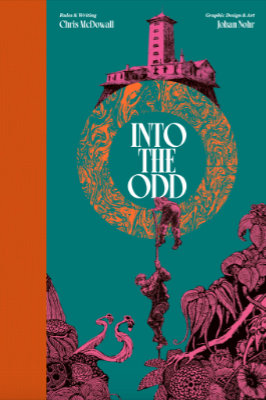
I picked up Into the Odd, Remastered when it was first released by Free League back in 2022. I read it right away but, at the time, I felt the game might be almost too rules lite. But that was a couple years ago and my tastes have changed. So I decided to revisit Into the Odd for Independent Role-Playing Game Month this year. I’m glad I did! Let’s take a look.
Core Mechanics
Into the Odd‘s core mechanic is the save. Players roll a d20 and attempt to roll equal to or under the most appropriate attribute for the check. A 1 is always a success and a 20 is always a failure.
Whenever a situation arises where a normal check isn’t appropriate, such as when a party makes a ruckus in a dangerous area, the Referee can make a luck roll using a d6. High rolls favor the players and low rolls trigger some sort of bad luck determined by the Referee. Checks for wandering encounters are a special form of luck roll. Whenever a party moves from one area to another in a populated region, such as a dungeon or wilderness, the Referee rolls a d6. A 1 triggers a random encounter, while a 2 gives a hint at a potential nearby encounter. I enjoy this mechanic, as it allows the dice to build up tension as a party explores.
Combat in Into the Odd is interesting because every attack hits. When an attack is declared the attacker rolls damage, from which the target subtracts their current armor score. If a character has not rested, or had either food or water, all attacks are impaired and damage is reduced to d4 damage no matter what weapon is being used. The reverse can also happen. When a character uses an attack the target is weak against the attack is enhanced and the damage is increased to a d12.
Hit Points are a character’s first pool of damage, for both PCs and NPCs. Once HP is reduced to 0 further damage is taken from a character’s Strength, and is considered a wound. Whenever a character takes damage to their Strength they must also make a Strength save or suffer Critical Damage. Characters in such a state must take a short rest and be tended to by an ally. If this is not done within one hour the character dies. Some creatures, however, can do horrific things to a PC if they ever suffer critical damage during combat–most of which present “colorful” ways to suffer an instant death. Combat is dangerous, and if it can be avoided, it is a wise option.
About Characters
Into the Odd may have the most simple character creation processes which has ever been devised for a tabletop role-playing game. Each character has three attributes–Strength, Dexterity, and Willpower. These scores are determined by a 3d6 roll, and applied to the attributes in the order listed. Each PC also begins play with 1d6 Hit Points.
Starting equipment is determined by taking a character’s highest attribute score and, using a table found on pages 10-11, comparing it to their starting Hit Points. Players see where the two values converge and write the equipment down on their sheets, adding any relevant information from the equipment list found on pages 12-13, and mark down any identifying characteristics which appear in the kit description. That’s it. If players would like, they can use the “Oddpendium” tables found in the back of the book to generate a character name, profession, and key capability. But it’s not necessary.
Characters advance by meeting one of the milestones listed on page 37. When a milestone is reached the player rolls a d20 for each attribute. If the result is greater than the current score, that attribute increases by one. Advancing characters also gain d6 hit points.
About Arcanum
Arcanum are the most sought-after items in the game, and are often the catalyst for any expeditions into the unknown. There are three levels of arcanum–normal, greater, and legendary–and both the powers and hazards associated with the arcanum increase with level. Some arcanum can be carried, while some legendary arcanum can be the size of a room.
These are also not simple “magic swords.” The abilities arcanum possess are unique, and are meant to be weird. There’s a list of arcana inside the book, but the “Oddpedia” includes two d100 tables for generating new arcanum on pages 134 and 135.
I like this design. It makes special items both weird and ripe with potential danger, and that is excellent flavor.
Beyond Delving
Into the Odd excels at exploration and dungeon crawling, but it also has some rules for what characters can do in-between expeditions.
As the characters advance their reputations will also increase, which will cause NPCs to treat them as “known figures”–though the type of treatment the PCs receive will depend on both their actions and the faction with which they’re interacting. If the party snatched a rare arcana from the grasp of a well-financed organization, for example, their “known” status may create enemies with which they’ll need to deal. A character’s reputation may also draw people who desire to apprentice with them. These are NPCs who are rolled up as characters and advance just like a PC does. In worst case scenarios, the apprentice becomes a nice back up PC if a player’s main character meets their demise. Depending how the main character perishes, it can also give the apprentice some motivations a player can use as role-playing fodder!
In addition to their reputation, characters may also invest money to start a new enterprise which can earn them profit. Enterprises cost 10 Guilders to establish and generate 1d4 Guilders income per month 1. The income is not automatic, however, as an enterprise will also suffer a threat which inflicts a 1d4 Guilder loss on the business if it’s not dealt with. If the loss is ever greater then an enterprise’s profit the business collapses, along with whatever money was invested in it. The nature of these threats isn’t specified in the rulebook, which gives a Referee a wide open space to create urban adventures as characters struggle to deal with whatever is threatening their business. Enterprises can also grow. Each month a business makes a profit their die type for both profit and loss increases one step–up to a d12. Threats to an enterprise can make for some wonderful adventure hooks!
If a party doesn’t want to be limit themselves to being small-business owners, they can further extend their influence by establishing detachments. Like enterprises, these cost 10 Guilders to establish, as well as 1d6 Guilders in upkeep each month. A detachment is treated as a single entity, and their base numbers can be increased by spending money on weapons and armor–for twenty times the listed equipment cost. Detachment attacks on individual targets are enhanced, doing d12 damage to their target, and they are immune to individual attacks unless they are explosive or “suitably large scale.” The rules for detachments are interesting, but could use a bit more fleshing out. Not much, as that would undermine the simplicity of the game’s design, but an example of play on how one might use detachments would be helpful.
Referee Stuff
Page 42 of Into the Odd is filled with materials for the Referee, what the game calls the Game Master. It begins with simple advice for running the game, including the basic duties of a Referee and how the save mechanic is meant to be used. It also includes advice for treasure, hazards, and designing encounters.
There’s also some bare bones advice on how to create creatures, followed by a few example monsters. When I first read the book I was a bit confused by the lack of a bestiary, but the more I have pondered the game the more I appreciate the design decision. Into the Odd is meant to be… odd…and providing too many typical tropes would have constrained the Referee from leaning into the oddness. Creating creatures is a simple process, and the example monsters serve as useful tutorials. They are more than enough to get started.
After the general advice Into the Odd has several pages on the game world, all described with its signature terse style. Each region in the world, including the main city of Bastion, is described much like an NPC. The flavor of the place is what matters, not the exact locations which can be found in each. This helps give some scaffolding for Referees to build their campaign, while also keeping the world open for them to develop as a result of play.
The final section in the book is the “Oddpedia,” which contains a number of tables a Referee can use to help resolve ways the game world responds to the character’s actions, but the tables are also a great resource for any other game a GM may want to run.
The Adventure
Pages 62-115 contain a sample adventure which functions as both an introduction for players and as an adventure creation tutorial for Referees. The adventure introduces a new town the PCs can spend time in, Hopesend, as well as a nice sized hex crawl which a party may traverse. The Sunken Marsh is a dangerous place, containing a number of mini-dungeons, is ripe with rumors, filled with potential random encounters, and descriptions for each hex.
The final part of the adventure, The Iron Coral, is a three level dungeon with sixty rooms to explore! Not only are the rooms presented using Into the Odd‘s terse style, they also include arrows pointing in the direction of the room’s exits and features. The dungeon’s maps are not a classic grid. Rather, they are presented in a hand-drawn style which indicates some of the basic contents of each room. It’s a beautiful design.
Between the intrigues of Hopesend, the hidden secrets of the Fallen Marsh, and the depths of the Iron Coral Into the Odd presents a wonderful sandbox for a starter campaign. It makes me want to run the system.
Layout
Into the Odd‘s interior design is unusual compared to other TTRPG books I’ve read. Margins are wide, which reduces the amount of text space on each page. This necessitates brevity for the throughout the book, which makes the game’s rules glanceable and allows the game to be easy to pick up and run. The few times this brevity works against the game, as with the rules for detachments, don’t out-weigh the benefits of this design choice.
The body text is a clean serif font while chapter titles are a decorative serif font with glyphs that are both tall and skinny. I’m a fan of the title font, it’s distinct and attractive.
I’m not certain how to describe the book’s artwork as anything other than “odd.” Most images seem to be composites of various elements, including photographs, which have been edited to share a similar color palette. Nothing feels quite “settled,” which is a perfect way to depict the game’s world. The more I examine the book the more I appreciate it.
There is only one heading level inside the book, their presentation contributes to the uniqueness of Into the Odd‘s layout. Headers are a bold san-serif font which are right-justified along the left page margin, and are presented with a significant amount of white space between it and the section above. The body text “below” the header it is set about 1/3 of the way across the page, beginning in-line with its heading, which makes tracking a topic’s beginning and end points easy. It also necessitates making rule descriptions even more terse than was already required due to the increased margin-size. Looking at the page, it seems almost as if the rules are laid out in a borderless table, with headings in one column and the associated text in another. I appreciate the bold design choice, and the skill it took to keep such terse descriptions useable for players and referees alike.
Book Design
Into the Odd is an A5 “digest” size book, weighing in at 146 pages. It’s a stitched binding hardback, so the book is durable. It’s also printed on flat paper and includes a book ribbon. All told, Into the Odd is a well-designed product with a great look and feel.
Conclusion
Is Into the Odd still too rules-lite for me? Not at all. The more I explore rules lite games the more I appreciate the concept. I’m bringing this game to a table as fast as I can because it’s dead simple and flavorful. If you want some old school danger with a fresh take on mechanics Into the Odd, Remastered is a great addition to your shelf!
Into the Odd Remastered can be purchased as a print book/PDF combination from Free League for $41.80 or as a PDF alone for $14.99 from DriveThru RPG. Check this one out.
-
In case you were wondering. 100 Pennies make a Shilling, 100 Shillings make Guilder. A Guilder is a lot of money. ↩

2 responses to “Into the Odd”
@dmtales.com @Tim_Eagon I quite like it, and the various derivatives like Electric Bastionland and Mausrítter. There’s probably as much detail as early D&D but done more coherently.
https://delta-pavonis.blogspot.com/2022/06/first-impressions-into-odd-remastered.html?m=1
LikeLike
Remote Reply
Original Comment URL
Your Profile
Why do I need to enter my profile?
This site is part of the ⁂ open social web, a network of interconnected social platforms (like Mastodon, Pixelfed, Friendica, and others). Unlike centralized social media, your account lives on a platform of your choice, and you can interact with people across different platforms.
By entering your profile, we can send you to your account where you can complete this action.
I do enjoy running it. It’s all flavor and discovery. Just got done my first adventure in the system…all but one character died, but the game was FUN. They kept retreating from danger moving deeper and deeper into the crawl as they did so.
LikeLike